Three Skulls: A Craft Fair-Ready Halloween Embroidery File
First Impression: Bold, Playful, and Instantly Recognizable
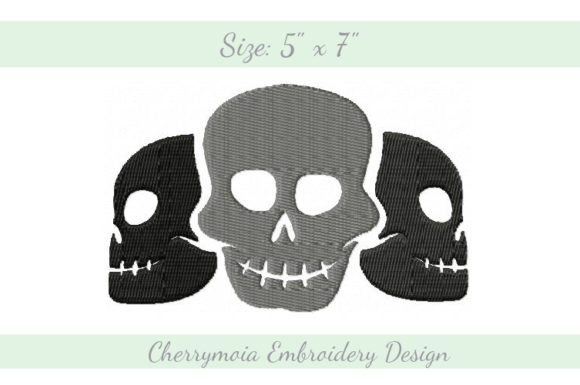
When I opened Three Skulls for the first time, my immediate thought was: this is booth bait. It’s not cute-cute or spooky-serious—it lands somewhere perfectly balanced: bold enough to stop a shopper mid-aisle, playful enough to invite a smile, and graphic enough to read clearly from six feet away. That’s rare in machine embroidery design. No florals, no script, no clutter—just three distinct skulls arranged with confident spacing and clean line work. For craft fair sellers and Etsy sellers building a cohesive Halloween collection, Three Skulls delivers instant mood without sacrificing handmade integrity.
Where It Shines: Product-by-Product Reality Check
In my booth prep tests, Three Skulls performed strongest on products where scale and contrast work in its favor:
- Tote bag design: Centered on a natural canvas tote, it reads as modern folk art—not costume-y. Customers consistently paused, pointed, and asked, “Is that hand-stitched?” (It’s not—but the stitch density and clean outlines sell the illusion.)
- Apron embroidery: Placed just above the pocket on a black or charcoal apron, it adds irreverent charm without overwhelming function. Works especially well for bakeries, coffee shops, and indie makers who lean into personality over polish.
- Embroidered patch: This is where Three Skulls becomes ultra-versatile. Iron-on or sew-on, it transforms plain denim jackets, backpacks, and market bags into curated handmade products. Small shop owners love patches—they’re low-risk inventory and high-margin add-ons.
- Tea towel embroidery: On tightly woven linen or cotton tea towels, the design holds crispness beautifully—if you use the right stabilizer. Avoid terry cloth or heavy waffle weaves; the stitch density needs smooth fabric texture to resolve cleanly.
- Caps and small pouches: Here’s the caveat: Three Skulls works best at medium scale. On curved cap fronts, shrink it below 3” wide and tiny details blur. Same goes for 4”x6” fabric pouches—go full-size or skip it. It’s not a “tiny accent” design; it’s a statement.
What Buyers Actually Notice (and Why It Sells)
At last month’s fall craft fair, I displayed Three Skulls on four items: a black market bag, a cream apron, a navy tea towel, and a set of three embroidered patches in a kraft box. The patches sold out first—not because they were cheapest, but because they were easiest to visualize on *their own thing*. Buyers held them up, snapped photos, and said, “I’ll put this on my daughter’s backpack.” That’s engagement. That’s conversion. Three Skulls feels giftable, ownable, and repeatable. It doesn’t scream “Halloween only”—it whispers “I’ve got taste and a sense of humor.” That duality makes it strong for year-round handmade product lines, especially when paired with neutral bases and intentional thread colors.
Production Practicalities: What Your Machine (and Your Time) Will Thank You For
This is a digital embroidery file—not a printable mockup or SVG. Before you load it into your commercial embroidery machine, do these five things:
- Test on scrap fabric that matches your final product—especially if using dark fabric or textured towels. Thread contrast matters more than you think; light gray thread on black canvas can vanish unless you choose matte polyester or rayon with depth.
- Check spacing and hoop size. If your machine requires re-hooping mid-design, confirm whether the layout allows for clean registration. Dense stitch areas near the eye sockets need stable hooping—don’t skimp on cutaway stabilizer for caps or structured pouches.
- Review stitch density. High density = rich detail, but also higher thread break risk on older machines or with budget threads. If you’re batch-producing 50+ tote bags, run a 10-piece test first.
- Compare fabric colors. Three Skulls gains warmth on oatmeal linen, edge on charcoal denim, and vintage charm on washed canvas. Skip neon or metallic fabrics—the design’s strength is its clarity, not flash.
- Confirm commercial licensing. Since this is a digital embroidery file intended for finished product resale, verify usage rights before listing on Etsy or shipping to boutiques. “I do” in the description hints at creator ownership—but always double-check terms.
Booth & Brand Impact: Beyond the Stitch
On a crowded craft fair table, Three Skulls stands out by being *intentional*, not loud. It supports brand consistency for makers who balance wit with craftsmanship—think small-batch apothecaries, indie bakeries, or gift-focused boutiques. When styled with matching thread palettes (charcoal + bone, rust + cream, deep green + oat), it reads as part of a thoughtful collection—not a seasonal afterthought. And because it photographs cleanly (no fuzzy edges, no stitching bleed), your Etsy seller listings and social posts gain credibility fast. No filters needed. Just good design, well-executed.
Careful-Use Notes: Protect Your Reputation & Repeat Sales
Don’t resize Three Skulls beyond ±15% of its original dimensions. Tiny details—like the subtle contouring around each skull’s jawline—dissolve under aggressive scaling. Avoid dense fabrics like thick fleece or quilted canvas unless you adjust tension and stabilizer weight. Curved surfaces (caps, curved pillow covers) require precise digitizing—check that the file includes underlay and pull compensation. And never embroider it on dark fabric without testing thread opacity first; what looks sharp on screen may read muddy in person.
Final Thought: A Smart Addition to Your Digital Design Assets
Three Skulls isn’t just another Halloween embroidery file. It’s a versatile, production-ready machine embroidery design that bridges craft fair charm and commercial viability. For embroidery business owners, Etsy sellers, and boutique makers, it’s the kind of design that earns compliments, drives cross-sells (patches + totes + aprons), and builds recognition across seasons. Just remember: respect the file, test thoroughly, and let the bold simplicity speak for itself. That’s how handmade quality wins—and how craft fair customers become repeat buyers.